 |
|


 Capabilities


|
|


|
Construction Products SADC
Background Murray & Roberts first entered the construction materials and services market in the 1950s, acquiring various businesses over time that manufactured and traded construction materials and services in the domestic and regional building and infrastructure markets. The nature and focus of the construction products and services businesses have changed often over the almost 50 years since then. A fundamental business principle has always been to service the construction industry in general rather than vertically integrate within Murray & Roberts specifically. There are occasions, however, where it makes sense to combine various Murray & Roberts operations in a unitary structure for improved competitiveness. This philosophy has focused management teams on service, quality, product development and price competitiveness to the extent that group companies constitute only about 5% to 10% of the average debtor book. The businesses in this cluster are market leaders, with management teams that understand the responsibility this brings to them and the Group. Market environment The primary commodity inputs for the construction products manufactured by Murray & Roberts are scrap steel, bitumen, cement, aggregate, clay and electricity. The commodity service to get the products to market is transport logistics. Bitumen has been extremely volatile both in price and availability over the past year. Cement price increases remained in line with inflation and aggregate prices increased faster than inflation. The price of scrap steel increased in the final quarter of the financial year. Electricity and transport logistics costs have increased steadily over a number of years at a level significantly ahead of inflation. The impact of the global financial crisis on this sector over the past two financial years has been severe, compounded by declining activity in the building and construction sectors, but cushioned to an extent by Government’s infrastructure investment. With the exception of asphalt, reinforcing steel (rebar) and steel piping, product demand was down while pricing was more competitive. Leadership Orrie Fenn joined the Group in November 2009 and assumed full executive responsibility for the cluster. This released Andrew Langham to take up his appointment as financial director of Murray & Roberts Limited. Key leadership remained stable during the year, with Rob Noonan, Phillip Hechter and Trevor Barnard responsible for Murray & Roberts Steel, Much Asphalt and Rocla, respectively. New appointments were, however, made to strengthen leadership capacity. Paul Deppe transferred from Technicrete to take over responsibility for Hall Longmore, and Albert Weber transferred from his position as operations director at Rocla to managing director of the building products businesses, Technicrete and Ocon Brick. Operations
Murray & Roberts Steel The CISCO steel mill operated at full capacity through the year and sold its production in the domestic and international markets. However, the increased cost of scrap metal and electricity, plus a static steel price in the domestic market for most of the financial year, placed severe pressure on profit margins. The introduction of an iron ore price levy, effective only for the last two months of the final quarter, offered some relief but this was largely negated by the higher scrap prices. The Kosto mill in Mauritius finalised its capital expenditure program and commenced full production in the second half of the year. The mill performed satisfactorily, but was impacted by the prevailing economic environment as well as the high cost of stock acquired in the previous financial year. Planned public sector investment in transport, tourism and social infrastructure in Mauritius offers the potential for future growth in the Indian Ocean Island region. Distribution volumes of rebar were supported in the first half year by the supply of product to the Gautrain project and work at the Medupi and Kusile power stations, but the availability of large new contracts at acceptable margins dissipated in the second half-year, causing the company to shift its focus to smaller projects in the domestic market. A strong focus on safety was maintained during the year and this was reflected in a reduction in the LTIFR to 9,1 (2009: 11,1). The first intake of an apprentice school for artisans, initiated by Murray & Roberts Steel, all passed their first year of study and have started their second year. The second intake commenced studies in July 2010. Plans are underway to introduce a school for rebar fixers in Johannesburg in the future. Volatility in global markets and local market dynamics have placed severe pressure on Murray & Roberts Steel and the Group has undertaken a strategic review and repositioning of the business. This may entail the closure or sale of underperforming assets.
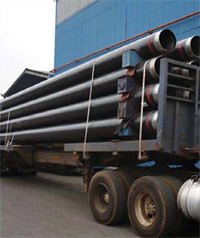
Hall Longmore The R2 billion contract to supply over 700 kilometres of steel pipe for Transnet’s National Multi- Product Pipeline (NMPP) from Durban to Johannesburg accounted for approximately 70% of Hall Longmore’s business during the year. In preparation for the NMPP project the company initiated a significant capacity expansion, including a major upgrade of the ERW plant and a new coating facility which has increased the company’s overall pipe manufacturing capacity to 250 000 tonnes per annum. The first-part order of the pipeline was completed before year end and delivery of the large bore Ø610 mm pipeline was completed in August 2010. The upgraded plant increases Hall Longmore’s capability to manufacture pipe by the more efficient ERW method, but, while the company has a reasonably strong order book in the spiral piping market, it has had less success securing sufficient work in the ERW market to fill the capacity gap created by the completion of the NMPP project. The business has embarked on a strategy to develop export markets in Africa and further afield for this purpose, and is strongly focused on becoming the lowest cost producer in a competitive market environment. Hall Longmore reduced its LTIFR to 4,5 (2009: 5,0). The company invested R600 000 in engineering and artisan bursaries in the year.
Much Asphalt Much Asphalt supplied more than 1,4 million tonnes of asphalt to a number of major public sector road infrastructure programs in the year, including the Gauteng Freeway Improvement Program, projects on the R300 and N1 near Cape Town and the Johannesburg Bus Rapid Transport System. Despite severe constraints in the supply of aggregates and bitumen, the company delivered on its commitments throughout the year, and all contracts scheduled for substantial completion for the 2010 FIFA World Cup were completed on time. Much Asphalt commissioned two new plants in the Johannesburg region, both of which utilise the latest environmental technology. The plants each have output in excess of 250 tonnes per hour and have increased overall capacity by 45%. They comply with environmental legislation and will enable Much Asphalt to reduce its carbon footprint. The company has made good progress in embedding a safety culture and ended the year with a LTIFR of 4,0 (2009: 9,8). Transformation is a key element of Much Asphalt’s market strategy and this is reflected in the company’s achievement of a level 3 BBBEE contributor status.
Rocla Rocla focused on contracts to supply projects in the power, road, rail, water and sanitation infrastructure sectors while its markets in the residential and commercial development sectors declined to below 20% of revenue. Rocla has adapted to increased competition as a result of recent growth in the South African market. Its strategy to improve operational efficiencies and pursue future opportunities in new product and geographic areas gained momentum as the business developed innovative products for the Gautrain and Gauteng Freeway Improvement projects and sought licence agreements with international suppliers of concrete products. Rocla is well positioned for growth in the sanitation market in the SADC region and future rail opportunities in South Africa. The company focused strongly on improving safety standards in its operations and this is reflected in a significant reduction in its LTIFR to 4,4 (2009: 11,2). The company is a level 6 BBBEE contributor and appointed its first black branch manager during the year.
Building Products (Technicrete and Ocon Brick) Murray & Roberts has brought Technicrete and Ocon Brick together under the umbrella of Murray & Roberts Building Products, which operates as one company to strengthen synergies and improve financial performance, but retains their distinctive individual brands. In a challenging year in which work opportunities in its building, infrastructure and mining markets remained limited, Technicrete reduced its labour force by 17% and reallocated or mothballed equipment to achieve optimum efficiency. Future growth will be sought from the development of more specialised products as well as market consolidation. Ocon Brick was heavily impacted by flat market conditions that prevailed for much of the year, although there are signs of improvement in the private residential development market. The business has been restructured to improve efficiencies. Improvements in the safety records of both businesses were reflected in a combined LTIFR of 2,8 (2009: 5,1). Technicrete and Ocon Brick are level 6 and level 5 BBBEE contributors respectively. Orrie Fenn
|
|||||||||||||||||||||||||||||||||||||||||||||||||||||||||||||||||||||||||||||||||||||||||||||||||||||||||||||||||||||||||||||||||||||||||||||||||||||||||||||||||||||||||||||||||||||||||||||||||||||||||||||||||||||||||||||||||||||||||||||||||||||||||||||||||||||||||||||||||||||||||||||||||||||||||||||||||||||||||||||||||||||||||||||||||||||||||||||||||||||||||||||||||||||||||||||||||||||||||||||||||||||||||||||||||||||||||||||||||||||||||||||||||||||||||||||||||||||||||||||||||||||||||||||||||||||||||||||||||||||||||||||||||||||||||||||||||||||||||||||||||||||




























© 2010 Murray & Roberts - All rights reserved. |