 |
|


 Capabilities


|
|


|
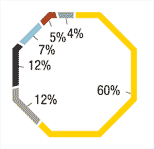
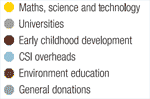
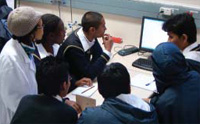
Community developmentMurray & Roberts is integrated with its society and its business activities have an impact on the communities in which they are undertaken. The Group is committed to managing this impact responsibly and accepts that its obligation extends beyond statutory requirements to the upliftment of society as a whole. The Murray & Roberts corporate social investment (CSI) program focuses on development projects aligned with the Group’s business strategy, supporting mathematics, science and technology education, numeracy and literacy education in early childhood development and environmental education. Murray & Roberts supports sustainable social development through many of its community initiatives. A number of employees participate in community development as champions of projects the Group supports. Investment of R22,2 million (2008: R21,1 million) in CSI projects during the year under review includes funding for the Murray & Roberts TRAC Laboratories at the University of Zululand Science Centre, Richards Bay and at Observatory, Johannesburg; South African Institute of Mechanical Engineers Technology Olympiad; Maths, Science and Technology in Engineering project developed by the Maths Centre; the National Business Initiative’s Mathematical Literacy Pilot Project: Professional Development of Teachers; laboratory upgrades for the School of Civil and Environmental Engineering at the University of the Witwatersrand; and The Molteno Institute for Language and Literacy. Murray & Roberts has seconded a senior executive to the University of Witwatersrand to assist with the university’s significant capital expansion program.
The Murray & Roberts construction businesses undertake project specific socio-economic development initiatives. An example includes a partnership with the South African Department of Defence, where 23 members were trained at the Murray & Roberts Construction Centre of Excellence in construction supervision and a further 75 in various trades, including bricklaying, plastering and tiling, carpentry and painting, and decorating. The Department of Defence members graduated with Construction Education and Training Authority recognised qualifications and related site exposure. Murray & Roberts supports the Chair of Environmental Education at Rhodes University, a Chair of Mechanical Engineering at the University of the Witwatersrand, the Chair in Collaborative Governance and Accountability at the University of South Africa and the Chair in Construction Management at the University of Stellenbosch. Murray & Roberts has also funded the Next Generation Scholars Project at the University of Johannesburg, which is a subvention partnership aimed at establishing world class academic capacity in science and engineering disciplines. A number of awards are made each year
to recognise and reward initiatives that
contribute to the enhancement of society.
These include the Jack Cheetham Memorial
Award for development in sport and the
Letsema Award for sportspeople with
disabilities, the Des Baker Award for
students of architecture and the JD Roberts
Award for environmentally sustainable
solutions to human dilemmas.
Murray & Roberts also supports the work of the South African Business Coalition Against HIV and AIDS, the World Wildlife Fund and the Business Trust. Through our contributions of R1,5 million, Murray & Roberts is one of many partner companies within the Business Trust and these funds have contributed to the achievement of program objectives and provided income and work for some 1,5 million people. We have supported Business Against Crime for several years, allocating over R700 000 towards efforts aimed at crime prevention strategies and projects. In addition, the Letsema Sizwe Broad-Based Community Trust (Sizwe) provides benefits to national and regional community groupings. The aim is to promote and enable social upliftment of the communities within which Murray & Roberts operates, including black youth, aged people, disabled people and black women. To date, the Sizwe trust has distributed R60,6 million towards the empowerment of designated groups. In 2010 Sizwe distributed R22,0 million to more than ten beneficiary organisations, including the Jack Cheetham Memorial Award and the Letsema Award winners and runners up. The majority of the funds were distributed to the following beneficiary organisations, which have been beneficiaries of Sizwe since 2007:
Murray & Roberts undertakes various enterprise development activities through its group operating companies. Activities include the procurement of subcontractors from small, medium and micro enterprises (SMMEs), early payment to SMME suppliers, preferential credit terms for buyers and administration support for certain customers. The Group and its subsidiaries belong to all the associations and organisations relevant to our sector, including the South African Federation of Civil Engineering Contractors, the Steel and Industries Federation of South Africa and the National Business Initiative, where we are actively involved in their Education College Industry Partnerships (CIP) program aimed at building strategic partnerships between companies and Further Education and Training (FET) colleges to address skills shortages. The CIP’s biggest contribution to date to the FET sector has been the revision of the National Curriculum Vocational Building and Civil program in collaboration with the previous administration of the Department of Education. Coupled with the revision and roll out of a new curriculum that is more relevant and responsive to the needs of the world of work, the partners have also funded extensive lecturer support opportunities. These efforts include the training of approximately 200 civil and building lecturers on the revised curriculum since 2008. The training takes place in Cape Town and Tshwane and is open to lecturers across all 50 FET colleges demonstrating the wider reach of the partnership in the country at no cost to the colleges apart from transport and accommodation. Murray & Roberts is committed to the principle of zero harm to the natural environment in all operations and activities conducted. The Group’s performance against environmental standards remained acceptable during the year, with more attention given to recording and reporting of environmental data and incidents.
|


© 2010 Murray & Roberts - All rights reserved. |