|
|
Major projects
CONSTRUCTION SADC
| GAUTRAIN RAPID RAIL LINK
The Gautrain Rapid Rail Link is one of the largest public private partnerships in the world and
offers a world class and cost effective, efficient, environmentally friendly and safe solution to
commuter and transport challenges in the rapidly developing Gauteng Province. The project also
seeks to provide partial relief to the challenge of road congestion by introducing an alternative
mode of transport for commuters. It supports economic growth in the province and is creating as
many as 7 000 employment opportunities during the construction and commissioning phase.
The project comprises five anchor stations in Johannesburg, Sandton, Pretoria and at
OR Tambo International Airport. Additional stations along the route include Rosebank,
Marlboro, Midrand, Centurion and Rhodesfield. There is a commuter link between Pretoria,
Johannesburg and Kempton Park and an airport express between OR Tambo and Sandton.
The 20 year concession to design, build, part-finance, operate and maintain the 80 kilometre
transport system is held by Bombela Concession Company (BCC). Murray & Roberts is a 25%
shareholder in both BCC (where group CE Brian Bruce is chairman, Terry Rensen a director
and Jerome Govender CEO) and turnkey contractor Bombela TKC (where Ian Thoms is
project director and Keith Smith and Malose Chaba directors). Murray & Roberts is a 45%
shareholder in the Bombela Civils Joint Venture (where Keith Smith is chairman and Cobus
Bester a director). Murray & Roberts is a 24% shareholder in Bombela Operating Company,
where Judy Van Es is chairman and the lead Murray & Roberts director.
Design and construction of the project commenced when commercial close was achieved in
September 2006. Despite delays with the procurement and delivery of land and the resultant
disruption of the works, Bombela ensured that completion of phase 1 (the network between
Sandton and OR Tambo), was completed in time for the 2010 FIFA World Cup. Design and
construction work was about 95% complete at year end. Phase 2 of the system from Park
Station to Hatfield via Pretoria Station is being constructed concurrently with the operation of
phase 1, but has been disrupted by delays in land delivery and considerable challenges with
dolomites in the Centurion area. |
|
LOCATION: Gauteng, South Africa
PROJECT CEO: Jerome Govender
PROJECT DIRECTOR: Ian Thoms
CLIENT: Gauteng Provincial Government
acting through the Gautrain Management
Agency
PARTNERS:
25% Strategic Partners Group,
17% Bombardier, 17% Bouygues
PROJECT TYPE: Public private partnership
VALUE: R25 billion plus claims and
variations
DURATION: 54 months and 15,5 year
operational concession
PROJECT START: September 2006
 |
|
 |
| Jerome Govender |
|
Ian Thoms |
|
|
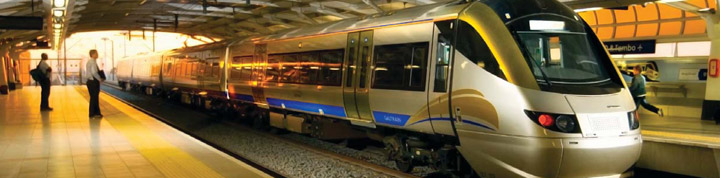 |
Gautrain station at
OR Tambo International Airport |
| Milestones |
| |
| • |
Operation of phase 1
commenced 19 days ahead
of schedule and 3 days before
the 2010 FIFA World Cup |
| • |
Approximately 400 000
passenger trips were recorded
on Gautrain trains and buses
in the first month of operation |
| • |
At end July 2010, The UCW
Partnership had completed
assembly of approximately 98%
of its portion of the Gautrain
rolling stock |
| • |
At end July 2010, approximately
65 million man hours had been
achieved on the infrastructure
portion of the project |
|
|
| GREEN POINT STADIUM
South Africa is the first African nation to host the prestigious FIFA World Cup. New stadiums
were built in Cape Town, Durban, Port Elizabeth, Polokwane and Nelspruit in preparation for the
2010 event, and other stadiums around the country were renovated to meet FIFA requirements.
The new Green Point Stadium, also known as Cape Town Stadium, was handed over to the
City of Cape Town ahead of schedule on 21 December 2009. The stadium successfully
hosted nine World Cup matches, including a semi-final, and will have a positive impact on
communities and economic growth in the Western Cape Province for years to come.
The 68 000 seat stadium is located on Green Point Common close to the V&A Waterfront and
Cape Town city centre. The stadium is 55 metres high with a fabric façade and a steel cable
tensioned glazed roof.
This world class venue has been designed not only to offer football fans an unforgettable
experience, but also with a view towards giving the people of Cape Town a versatile venue
for decades.
A review team appointed by the Department of Environmental Affairs and Tourism has found
that the Green Point Stadium meets high standards of environmental protection. Water and
energy efficiency measures are part of the design and, when the old Green Point Stadium was
demolished to make way for the new one, 95% of the components were recycled and reused.
Water from the stadium roof and drainage from the pitch is pumped into ponds on Green Point
Common, thus reducing dependency on potable water. |
|
LOCATION: Cape Town, South Africa
PROJECT MANAGER: Andrew Fanton
CLIENT: City of Cape Town
PARTNER: 50% WBHO
PROJECT TYPE: Construction
VALUE: R3,6 billion
DURATION: 32 months
PROJECT START: March 2007
PROJECT COMPLETED: December 2009
 |
| Andrew Fanton |
|
|
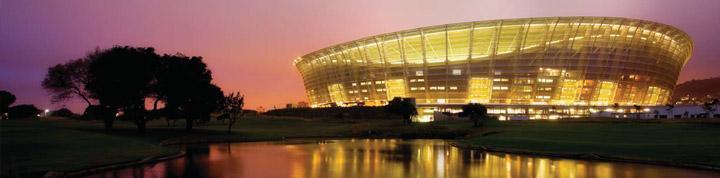 |
Green Point Stadium |
| Achievements |
| |
| • |
The project was handed over to
the client in December 2009,
two months ahead of the original
contract program |
| • |
2,7 million lost time injury free
hours were recorded to July 2009 |
| • |
1 200 trade employees were
trained, graded and developed
(The peak construction labour force
comprised 2 300 employees) |
| • |
The project invested in community
based social initiatives, including
support for abused women and
disadvantaged children |
| • |
More than 80 000 school
learners attended construction
presentations at the Visitor’s Centre |
|
|
CONSTRUCTION & ENGINEERING SADC
| MEDUPI AND KUSILE
Murray & Roberts is playing a pivotal role in the development of South Africa’s new power
station infrastructure with its major involvement in the construction of the Medupi and Kusile
power stations. These power stations are amongst the largest dry-cooled thermal power
stations in the world.
The need for new electricity capacity in South Africa has reached a critical stage and the
planned Eskom power generation program will reinstate reliable electricity supply to South
Africa and its neighbours over the next 20 years.
A number of Murray & Roberts companies are engaged in this program. Murray & Roberts
Projects, in partnership with Hitachi, is responsible for the boiler mechanical portion of the
works, comprising 12 units of about 800 megawatt electrical (MWe) each. The Murray &
Roberts scope includes structural steel fabrication, erection and mechanical installation works
for both power stations. Structural steelwork is being fabricated by Genrec and steel ducting
is being fabricated by Energy Fabrication.
Murray & Roberts leads the civil joint venture for the Medupi project where works have
progressed well on the first three of the six units. Concor, in joint venture, has been awarded
the chimneys and silo contracts for both the Medupi and Kusile projects.
The strategy and investment by the businesses during the early stages of the works to develop
South African resources are starting to show great benefit on the projects. The ASGISA trade
skills programs and learnerships are progressing well with approximately 720 artisans enrolled.
The professional development of engineers is currently a focus area and will remain a priority
over the next 18 months.
Both projects have been subjected to significant start-up delay as a result of late access,
inadequate site services and design challenges. |
|
LOCATION: Lephalale, Limpopo Province
and eMalahleni, Mpumalanga Province,
South Africa
PROJECT DIRECTORS: Bruce Neave
(Medupi mechanicals), Coenie Vermaak
(Medupi civils)
CLIENT: Eskom Holdings Limited
PARTNERS: Mechanical – Hitachi Power,
Civil construction – Grinaker LTA (33%)
PROJECT TYPE: Power generation –
mechanical, electrical and civil construction
VALUE: R18 billion (Medupi and Kusile),
R4,5 billion (Medupi civil construction)
DURATION: 120 months in total
PROJECT START: November 2007
 |
|
 |
| Bruce Neave |
|
Coenie Vermaak |
|
|
 |
Medupi power station under
construction (boiler mainframe and gas
ducting in centre of photograph) |
| Milestones |
| |
| • |
Medupi boiler 6 civil sectional
contractual handover achieved
with accelerated program |
| • |
Mechanical completion of
mainframe and auxiliary bay
structural steel for boiler 6 |
| • |
Fabrication of over 12 000 tonnes
structural steel |
| • |
Kusile duct workshop established
and commissioned |
| • |
Over 2,7 million work hours
achieved on boiler contract with
LTIFR of 0,07; CJV LTIFR 0,87 |
| • |
Over 14 million man hours worked |
|
|
CEMENTATION GROUP
| AQUARIUS PARTNERSHIP
The Kroondal and Marikana platinum mines are located 120 kilometres northwest of Johannesburg
in the Bushveld Igneous Complex in the North West Province. This region is one of the world’s
most productive platinum regions. These mines are amongst the most cost effective underground
platinum mines globally, with a total workforce of more than 6 200 people.
Murray & Roberts has a history dating back more than 80 years of serving the mining industry
and is recognised as a leading mining contracting group worldwide with a presence in Africa,
Australasia, Asia and North and South America. In 1999, Cementation Africa entered into a
landmark contract with Aquarius Platinum to toll mine the shallow platinum ore body at Kroondal.
A revised three year contract to the value of R2,5 billion annually was negotiated in July 2010.
Murray & Roberts Cementation provides most of the services required to undertake mining
activities and carries a shared responsibility for day-to-day operation of the mine, limited to
underground activities from initial production planning and mineral resources management
(including survey and grade control) to the final delivery of ore to the surface stockpiles. The
Kroondal processing plants are supplied from seven main producing shafts with a production
output of about 850 000 tonnes of underground ore per month blended with 60 000 tonnes of
opencast ore supplied by others. Mining ore is processed by Aquarius in the metallurgical plants
to produce a concentrate which is supplied to Impala Refining Services and RPM in Rustenburg.
The capital intensive small mine concept at Kroondal has revolutionised the South African
platinum mining industry and incorporates the use of key contractors, highly mechanised mining
operations and the outsourcing of high-cost, high-risk smelting and refining operations.
In accordance with the client’s business model, the operational activities at the mine are
outsourced to two specialised contractors. Murray & Roberts Cementation, with a workforce
of more than 5 950 people, performs underground mining and Minopex operates the
metallurgical plants. Other contractors perform the duties and responsibilities of service
departments such as rock engineering, ventilation and geology. |
|
PROJECT DIRECTOR: Freddie Geldenhuys
CLIENT: Aquarius Platinum South Africa
PROJECTS: Kroondal, Marikana, Blue
Ridge and Everest platinum mines
PROJECT TYPE: Contract mining
VALUE: R2,5 billion per annum
DURATION: Ongoing
PROJECT START: July 1999
 |
| Freddie Geldenhuys |
|
|
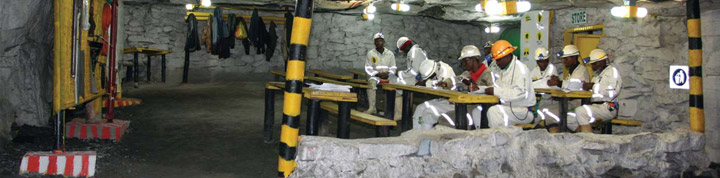 |
Underground training
at Kroondal Mine |
| Milestones |
| |
| • |
Three million fatality free shifts
on 26 February 2010* |
| • |
Overall safety performance
compares favourably with
industry |
| • |
Productivity levels ranked with
best in industry |
* Regrettably, subsequent to the year end, a fall
of ground incident at the Marikana Mine on
6 July claimed the lives of five employees.
Another fatality occurred on 13 August at the
Kroondal Mine. |
|
CONSTRUCTION PRODUCTS SADC
| NATIONAL FREEWAY IMPROVEMENT PROJECTS
Through its asset preservation arm, SANRAL, the Department of Transport has recognised
that Cape Town and Gauteng generate nearly 40% of the total value of South Africa’s
economic activities. As a result, development in housing, offices, retail and industrial properties
in the two centres has grown significantly over the past 10 years, resulting in above average
traffic growth. Provision of road infrastructure has not kept up with the increased traffic
demand, resulting in a road and freeway network that is under capacity.
The Gauteng Freeway Improvement Project (GFIP) has been implemented to upgrade and
expand the Gauteng freeway network to significantly reduce traffic congestion and unblock
access to economic opportunities and social development projects. The GFIP will inject
approximately R29 billion into the South African economy and approximately R13 billion into
the provincial gross geographic product, creating nearly 30 000 direct jobs over its lifecycle.
In anticipation of this development, Much Asphalt upgraded its facilities and capacity and,
as a consequence, has been contracted to supply about 70% of the asphalt required to
complete phase 1 of the GFIP.
Phase 1 is due for completion before the end of 2010. The initiative that crosses the
Johannesburg, Ekurhuleni and Tshwane metropolitan boundaries widens freeways to at least four
lanes in both directions and in some sections up to six lanes. This phase of the project will
upgrade 185 kilometres of the existing freeway network. Furthermore, over the lifespan of the
project, a further 376 kilometres of upgraded and newly constructed freeways are planned for
implementation. The network will provide an interconnected freeway system of inner and outer
ring roads, incorporating the historically-neglected western and southern Gauteng settlements.
The most significant contribution the investment will make to ordinary citizens is the quality of
life improvement that an upgraded road infrastructure will deliver. |
|
LOCATION: Johannesburg and Cape Town
PROJECT DIRECTOR: Bennie Greyling
CLIENT: South African National Roads
Agency (SANRAL)
CUSTOMER: 15 major South African
contractors and joint ventures
PROJECT TYPE: Manufacture and delivery
of asphalt surfacing materials
VALUE: R867 million
DURATION: 20 months
PROJECTS START: October 2008
 |
| Bennie Greyling |
|
|
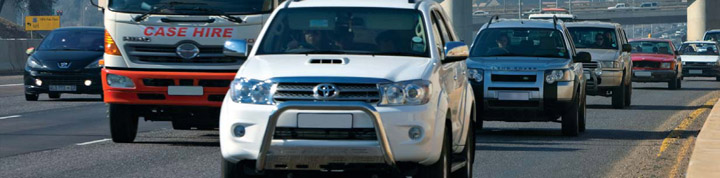 |
Upgrading Gauteng freeways |
| Milestones |
| |
| • |
GFIP: 870 000 tonnes of five
different specialist surfacing
products (R610 million) |
| • |
R300, Cape Town: 266 000
tonnes EVA modifi ed asphalt
(R162 million) |
| • |
N1, Cape Town: 151 000 tonnes
specialist surfacing products with
recycled asphalt (R95 million) |
| • |
All contracts scheduled for
substantial completion for 2010
FIFA World Cup delivered on time |
|
|
| MULTI-PRODUCT FUEL PIPELINE
To accommodate growth in demand for liquid fuels in Gauteng Province, Transnet allocated
R11,2 billion for the construction of a new multi-product fuel pipeline from Durban to
Johannesburg to replace and enlarge existing pipeline capacity. The National Multi-Product
Pipeline (NMPP) will transport petrol, diesel and jet fuel from the second quarter of 2011.
Although the pipeline has also been designed to transport crude oil, the wet commissioning
using crude oil will take place at a later stage.
Murray & Roberts operation, Hall Longmore, was awarded the order to manufacture and
supply the specialist pipe at a value of R2,4 billion. The order consists of approximately
560 kilometres of Ø610 mm line from Durban harbour to Nigel, and approximately
160 kilometres of Ø406 mm line from Nigel to Langlaagte, and from Watloo in Tshwane to the
terminus near Kendal Power Station.
Hall Longmore’s involvement with the NMPP began in 2006 with the submission of capability and
feasibility information. Significant technical involvement with the NMPP Alliance Joint Venture
culminated in the award of the order for the three layer coated pipe contract to Hall Longmore as
part of the Impumelelo Pipeline Joint Venture. Final delivery took place in August 2010.
In preparation for the NMPP project, Murray & Roberts approved a significant capacity
expansion at Hall Longmore, including a major upgrade of the electric resistance welded (ERW)
plant and a new coating facility to a capacity of 250 000 tonnes per annum. The upgraded plant
increases the company’s capability to manufacture pipe by the more efficient ERW method.
The upgrade to Ø610 mm and downstream improvements will enhance the company’s
capacity to take on future projects of this nature. Many positive spin-offs have emerged from
the NMPP project that will minimise wastage and lead to more efficient pipe-making.
|
|
LOCATION: Johannesburg, South Africa
COMPANY: Hall Longmore
PRODUCTION EXECUTIVE: Kelvin Pillay
CLIENT: Transnet
PARTNERS: Kulungile Metals Group
PROJECT TYPE: Pipe manufacture
VALUE: R2,4 billion
DURATION: Two years
PROJECT START: August 2008
 |
| Kelvin Pillay |
|
|
 |
The final delivery from
the NMPP pipeyard |
| Achievements |
| |
| • |
Manufacture of the fi rst
Ø610 mm pipe complying with
American Petroleum 5L
standards in grade X65 steel |
| • |
At 30 June 2010, supply of
the Ø406 mm line was complete
and 513 kilometres (90%) of
the Ø610 mm pipeline had
been delivered |
| • |
The project was completed
in August 2010 |
|
|
CLOUGH
| GORGON LNG PROJECT
The Greater Gorgon gas fields, off Western Australia’s Pilbara Coast, contain more than
40 trillion cubic feet (Tcf) of gas, representing some 25% of Australia’s total known gas
resources. The Gorgon project is the largest resource project in Australia’s history and will be
adding 15 million tonnes of LNG a year to Australia’s current annual output of approximately
20 million tonnes in a phased manner between 2014 and 2015.
Clough is a key member of the Kellogg Joint Venture – Gorgon (KJV-G), which has been
awarded by Chevron Australia the engineering, procurement and construction management
(EPCM) contract for all downstream facilities on the project.
The onshore facilities will consist of three five million tonne per annum LNG trains, gas processing
and treatment facilities, product storage and offloading, complete offsites, utilities and
accommodations. The EPCM contract also includes a 300TJ/d domestic gas plant. The design
of the facility features improvements in greenhouse gas emissions performance, including
improved waste heat recovery and the injection of reservoir carbon dioxide into the subsurface.
The EPCM effort is planned as a fully modular construction strategy to minimise impact on the
island during the construction phase, and is being conducted from two main operating centres
located in Perth, Australia and London, UK with support from global centres in USA, Singapore,
Indonesia and Japan. Global procurement and numerous international fabrication yards will be
utilised to supply the key components of the project and KJV-G personnel will manage these
global sites, including the critical supply chain management and logistics processes.
Early construction activity is well underway to ensure that the proper infrastructure and marine
logistics capability is established. A work force in excess of 3 500 personnel will construct and
commission the facilities over a three year period. It is anticipated that over 40% of the project
expenditure will occur in Australia.
Murray & Roberts Marine has been awarded a joint venture subcontract to design and construct
the material offloading facility for the Gorgon Project. |
|
CLIENT: Chevron Australia Pty Ltd
LOCATION: Barrow Island, Western
Australia
CLOUGH COO: Bill Boyle
CONTRACT VALUE: A$2,7 billion
(Clough 20%)
PARTNERS: Kellogg Brown Root (KBR),
JGC, Hatch
CONTRACT PERIOD: September 2009 –
present
SAFETY PERFORMANCE:
Man hours to 30 June 2010: 5 309 945,
LTIFR: 0
 |
| Bill Boyle |
|
|
 |
Gorgon Project, Barrow Island |
| Milestones |
| |
| • |
Five million man hours completed
without a days away from work
(DAFW) incident |
| • |
Major contract and procurement
commitments valued at about
US$14 billion were secured to
30 June 2010 |
| • |
Quarantine compliance plan
implemented on Barrow Island
rated world class by Western
Australian Government
Environmental Protection Agency
in 2009 EPA decision document |
|
|
INVESTMENTS
| COAL LINE AND ORE LINE
COAL LINE
The Richards Bay Coal Terminal (RBCT) is the second largest coal export facility in the world
and is expanding its capacity to accommodate increased coal exports. The Coal Line railway
system between eMalahleni (Witbank) and Richards Bay plays an important role in the successful
operation of RBCT. The Coal Line upgrade project is part of Transnet’s Main Line Locomotive
Investment Program that seeks to optimise the operation of the railway system in support of
the expansion of RBCT.
Murray & Roberts subsidiary, Union Carriage and Wagon, through The UCW Partnership
(UCWP) and with Mitsui African Railway Solutions and Toshiba as its partners, is contracted
to supply new locomotives for the Coal Line corridor. Through this project, Transnet will
acquire 110 class 19E dual voltage electric locomotives to be made available by 2012. UCWP
is responsible for the overall mechanical design, systems integration, fabrication and assembly
of the locomotives. Toshiba contributes to the design, development and supply of the electrical
propulsion equipment. The first 12 locomotives have successfully completed the mandatory
tests and have been in revenue earning operation since the first half of 2010.
ORE LINE
A dramatic increase in demand for South African iron ore in recent years compelled Transnet
to expand its locomotive fleet to facilitate higher volumes of iron ore exports.
In 2007, Transnet awarded UCWP, with its partners Mitsui and Toshiba, the project to supply
44 new class 15E 50 kV electric locomotives for the iron ore rail link from Sishen to Saldanha.
This is the most energy efficient locomotive that Transnet has ever added into its fleet. At
30 June 2010, 10 locomotives had been delivered. The first consignment of three locomotives
have successfully completed the mandatory tests and have been in revenue earning operation
since the second quarter of 2010. |
|
COMPANY: The UCW Partnership
CLIENT: Transnet Freight Rail
OPERATIONS DIRECTOR: Craig Holden
PARTNERS: Toshiba and Mitsui
PROJECT TYPE: Rolling stock
infrastructure
VALUE: R2,1 billion
DURATION: Four years
PROJECT START: September 2006
 |
| Craig Holden |
|
|
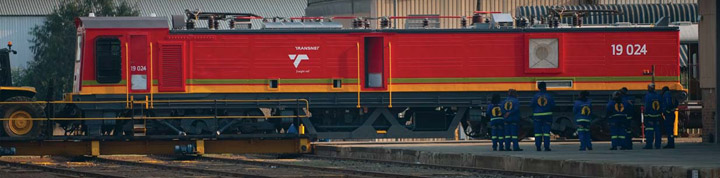 |
Class 19E dual voltage
electric locomotive |
| Milestones |
| |
| • |
800 new job opportunities
secured |
| • |
First major new electric
locomotive contracts in South
Africa since 1994 |
| • |
The program positions UCWP as
a supplier of choice for future
rolling stock opportunities |
| • |
Class 15E the most energy
efficient locomotive ever delivered
to Transnet |
| • |
At 30 June 2010, 35 new
locomotives had been delivered
to Transnet by the two projects |
|
|
|


 Capabilities


